☀️ End of Summer Sale: Save 50% on Hostaway & Uplisting Plugins | Code: SUMMER | Offer Ends August 31st!


☀️ End of Summer Sale: Save 50% on Hostaway & Uplisting Plugins | Code: SUMMER | Offer Ends August 31st!
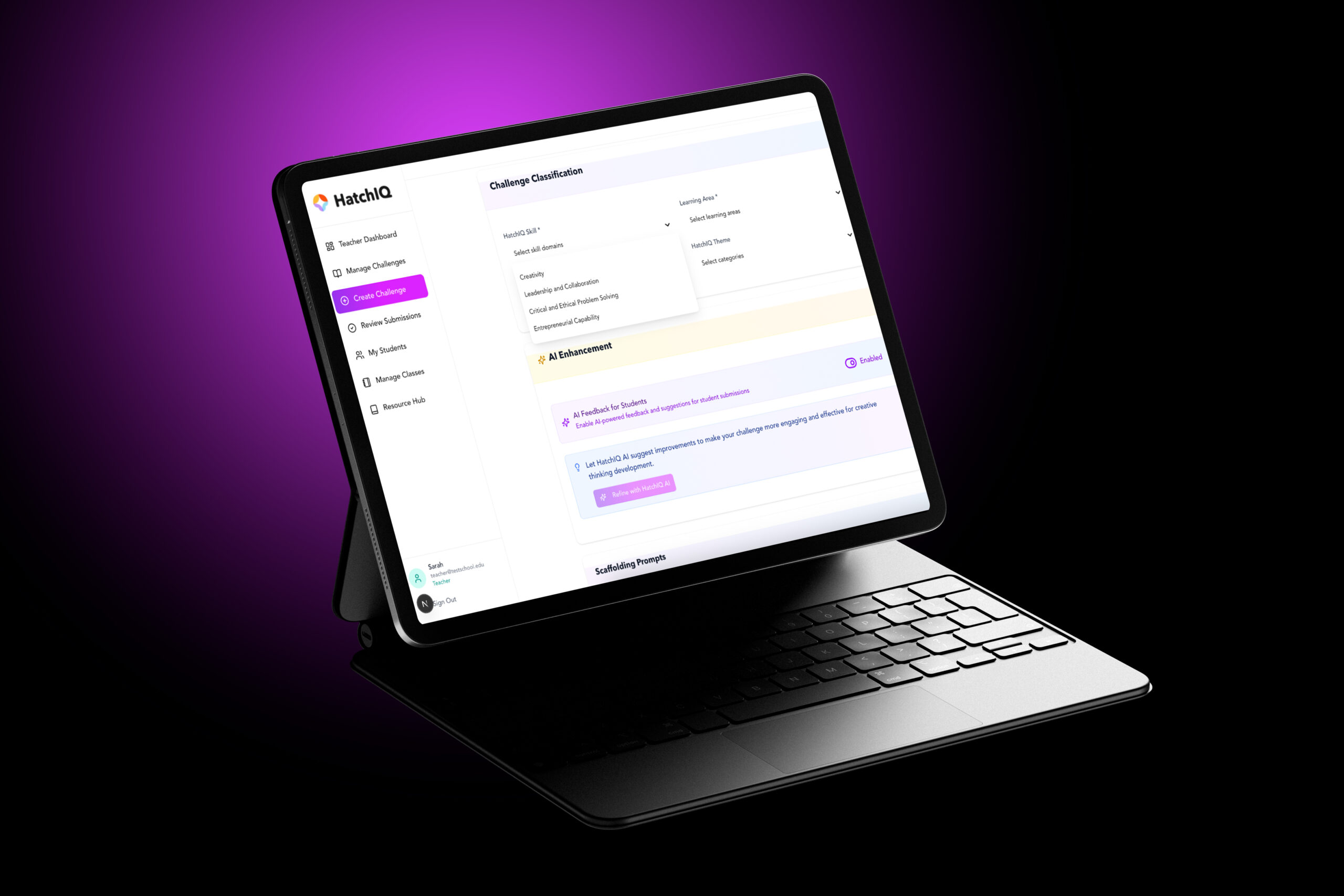


HatchIQ is an educational technology platform developed to address a longstanding and significant challenge encountered by contemporary educators: effectively managing classrooms without escalating administrative burdens.
Today, educational institutions and educators depend on numerous fragmented tools for classroom management, assignment development, student submissions, grading, and feedback. This fragmentation impedes educators’ efficiency and frequently undermines the quality and promptness of the feedback delivered to students.
HatchIQ was conceived as a comprehensive, integrated classroom management system—a platform enabling educators to oversee classes, develop and distribute assignments, review submissions, provide feedback, and monitor student progress seamlessly, without the need to switch between multiple tools or duplicate efforts.
At the core of HatchIQ resides a well-defined and intentional philosophy:
Artificial intelligence should assist teachers, not replace them.
The platform’s objective is to decrease teachers’ workload, enhance grading consistency, and expedite feedback processes—while maintaining human judgment, pedagogical oversight, and trust.
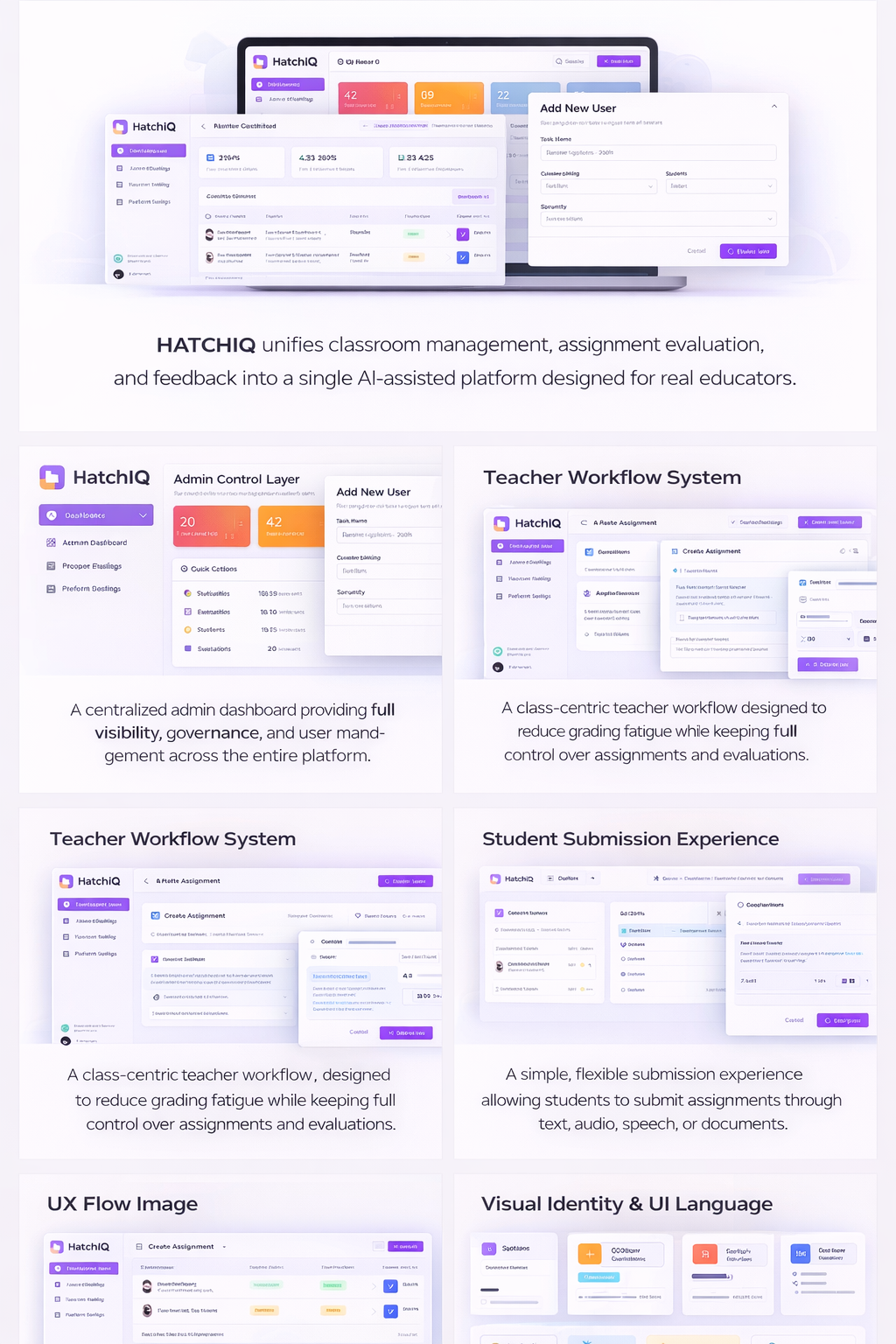
HatchIQ was not building a generic EdTech product or an experimental AI solution. The team was deeply focused on real classroom adoption, which required more than just technical execution.
They needed a product partner who could:
Rather than splitting responsibilities across multiple vendors, HatchIQ partnered with Bizdesire as an end-to-end product partner—covering everything from product strategy and UX to SaaS development and AI integration.
This unified approach ensured clarity of vision, faster execution, and consistency from concept to MVP.
HatchIQ needed to support three core user roles, each with fundamentally different needs:
Each role carried unique responsibilities, permissions, and data visibility. Without a clearly defined role architecture, the platform risked:
The challenge was to design a system where every role felt purpose-built rather than compromised.
Teachers spend a significant portion of their working hours reviewing repetitive assignments, leaving limited time for meaningful feedback and student engagement. However, automation alone was not the solution. The real challenge was trust. HatchIQ required AI-assisted evaluation that:
Any perception of automatic grading may significantly impede adoption, particularly within institutional settings.
Modern students submit assignments in multiple formats, including:
While this flexibility benefits students, it can overwhelm teachers if each format requires a different review process. The challenge was enabling submission flexibility for students while maintaining a single, consistent review workflow for teachers.
The platform was designed starting with roles—not features.
Every screen, action, and permission was mapped to a specific user role, ensuring:
This role-first foundation allowed HatchIQ to scale across classes, schools, and institutions without architectural rework.
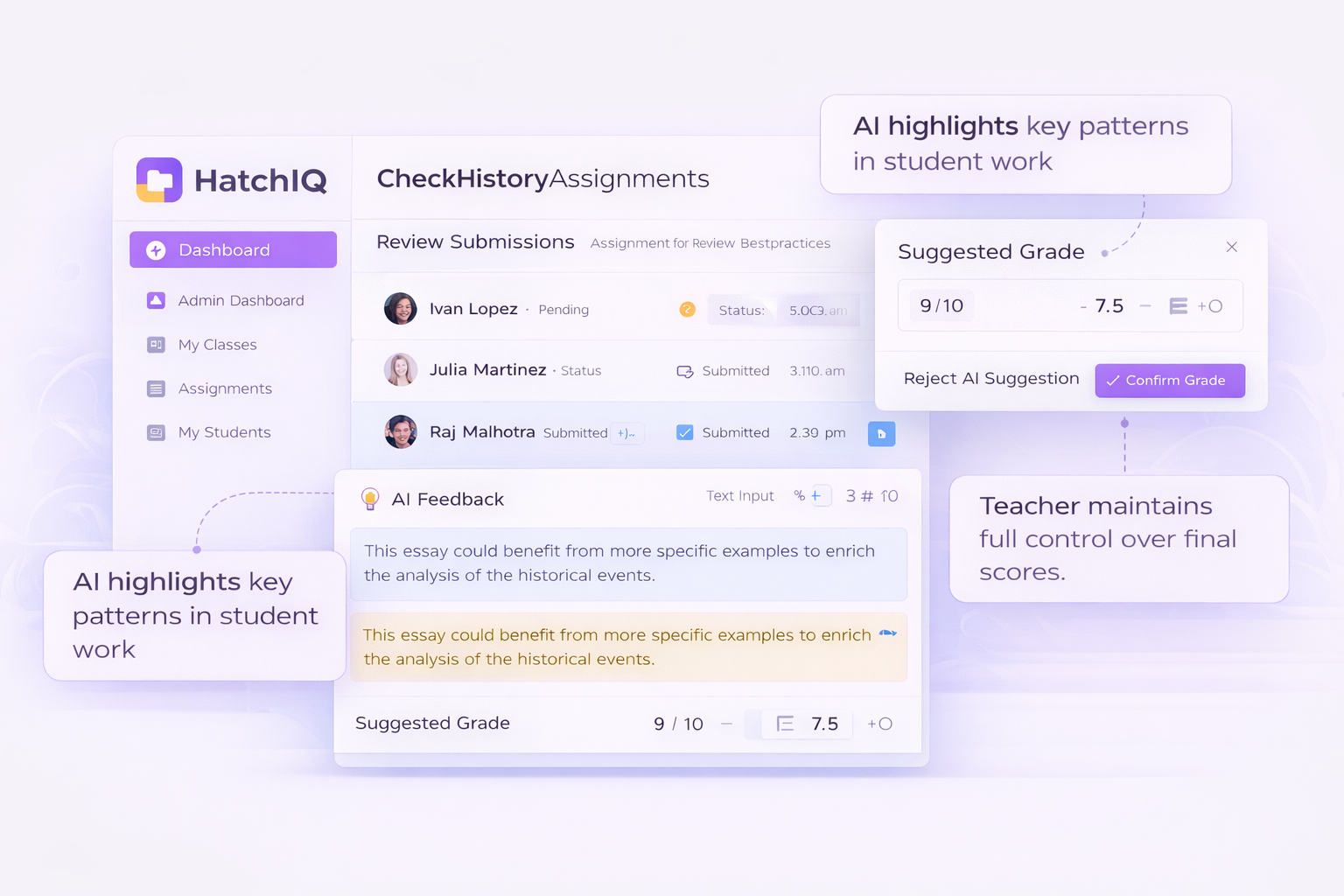
AI was intentionally positioned as a decision-support layer, not an authority.
AI assists teachers by:
Teachers always retain full control over grading and feedback.
This approach preserved trust, increased confidence in AI, and supported long-term adoption.
HatchIQ was designed as a multi-tenant SaaS platform that supports multiple schools and classes.
The MVP was not only functional but also future-ready, capable of institutional onboarding without major technical changes.
The process began with in-depth stakeholder interviews and discovery sessions to understand how classrooms actually operate, not how software assumes they do.
Key design priorities included:
Wireframes were validated early and refined continuously before development.
From a technical perspective:
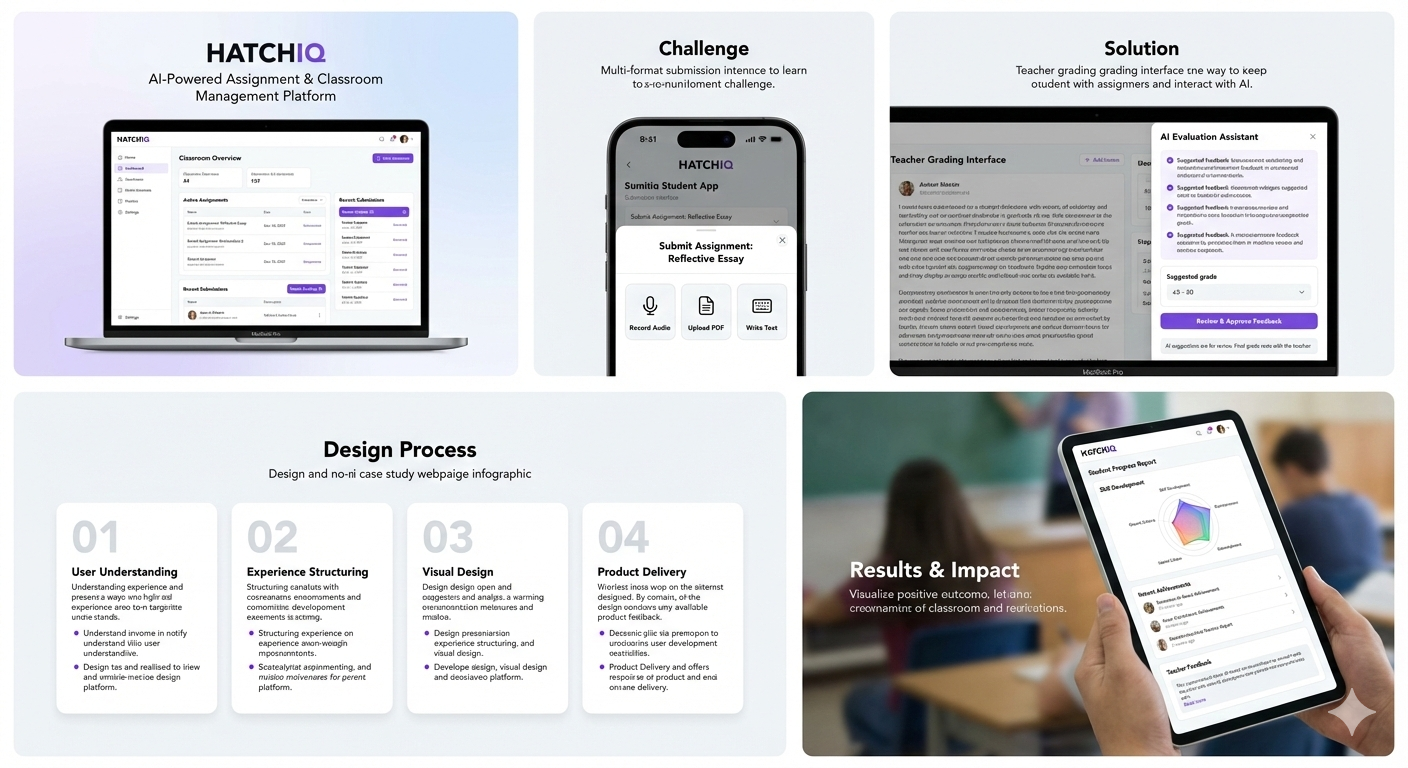
We began with stakeholder interviews to map real classroom workflows, ensuring the platform solved genuine educator bottlenecks rather than assumed ones.
Wireframes focused heavily on reducing teacher cognitive load, minimizing clicks, and eliminating unnecessary steps in the grading cycle.
We created a modular design system optimized for long reading sessions, validating every iteration for clarity before moving to production.
The platform was built with an API-first backend to support future mobile apps, advanced analytics, and deeper Al capabilities as the product scales.
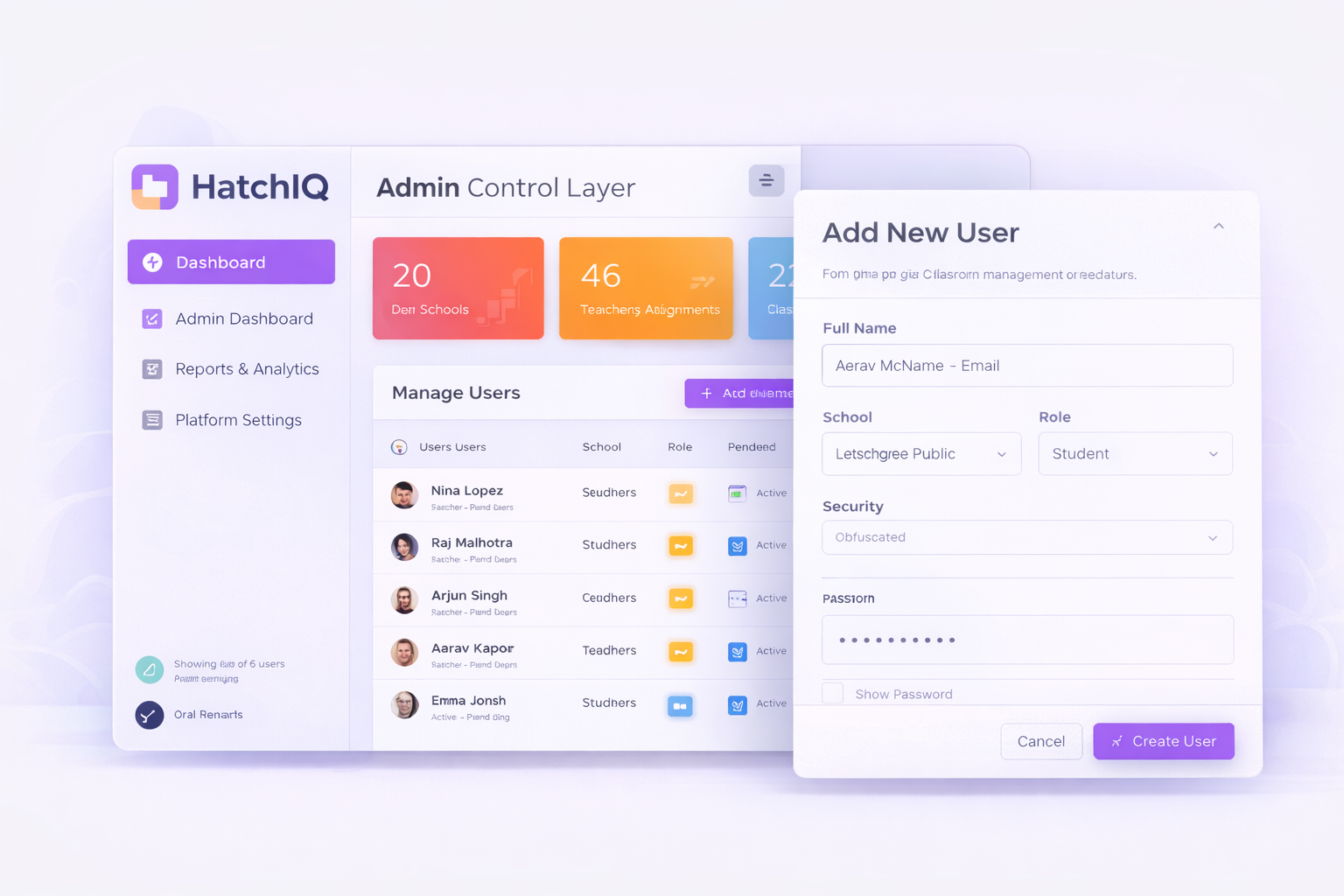
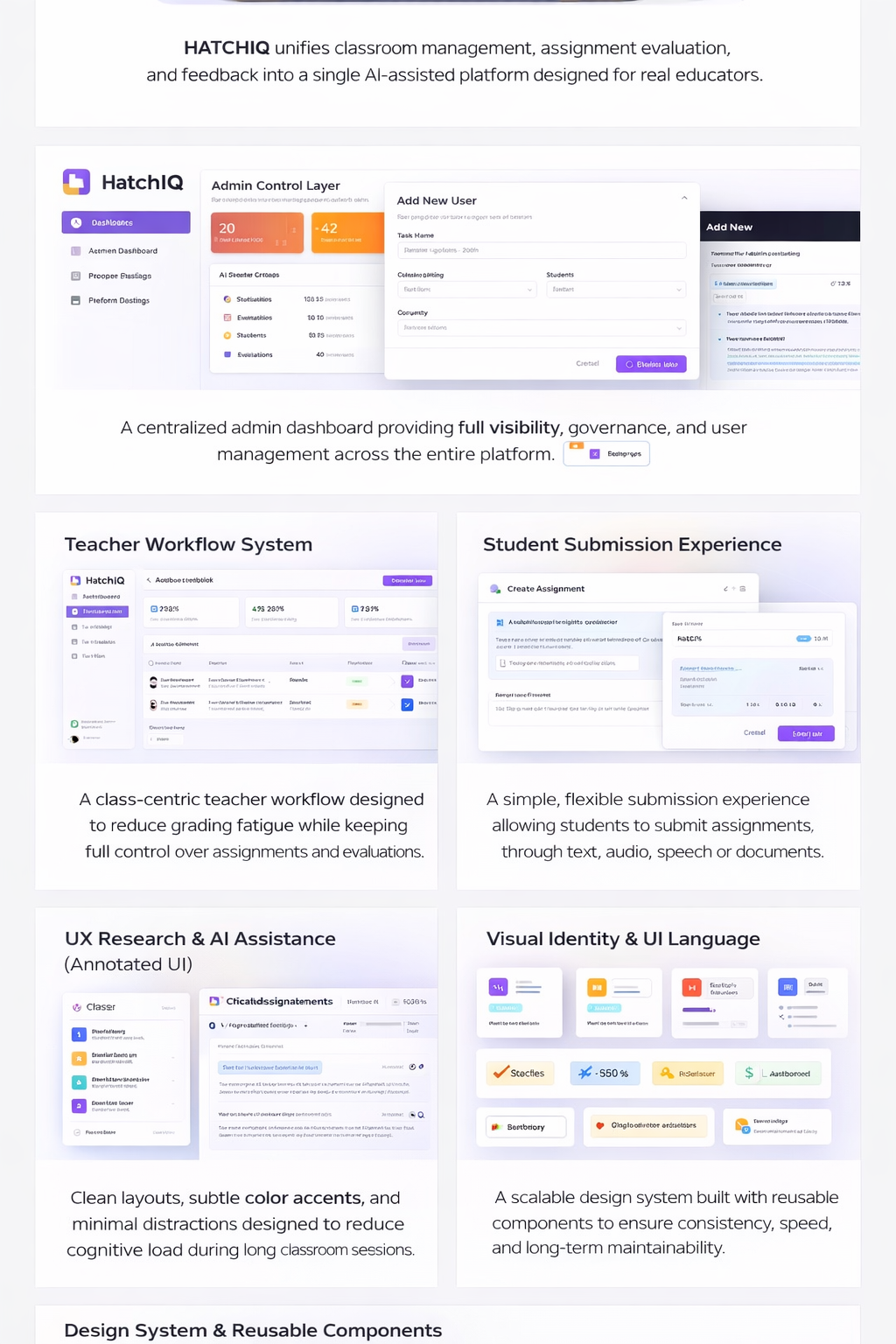
Administrators were provided with a centralized control system offering:
This ensured security, scalability, and operational control as adoption grows.
The teacher experience was designed to be class-centric, not feature-centric.
Teachers can:
Every interaction mirrors how teachers already think and work—reducing learning curves and resistance.
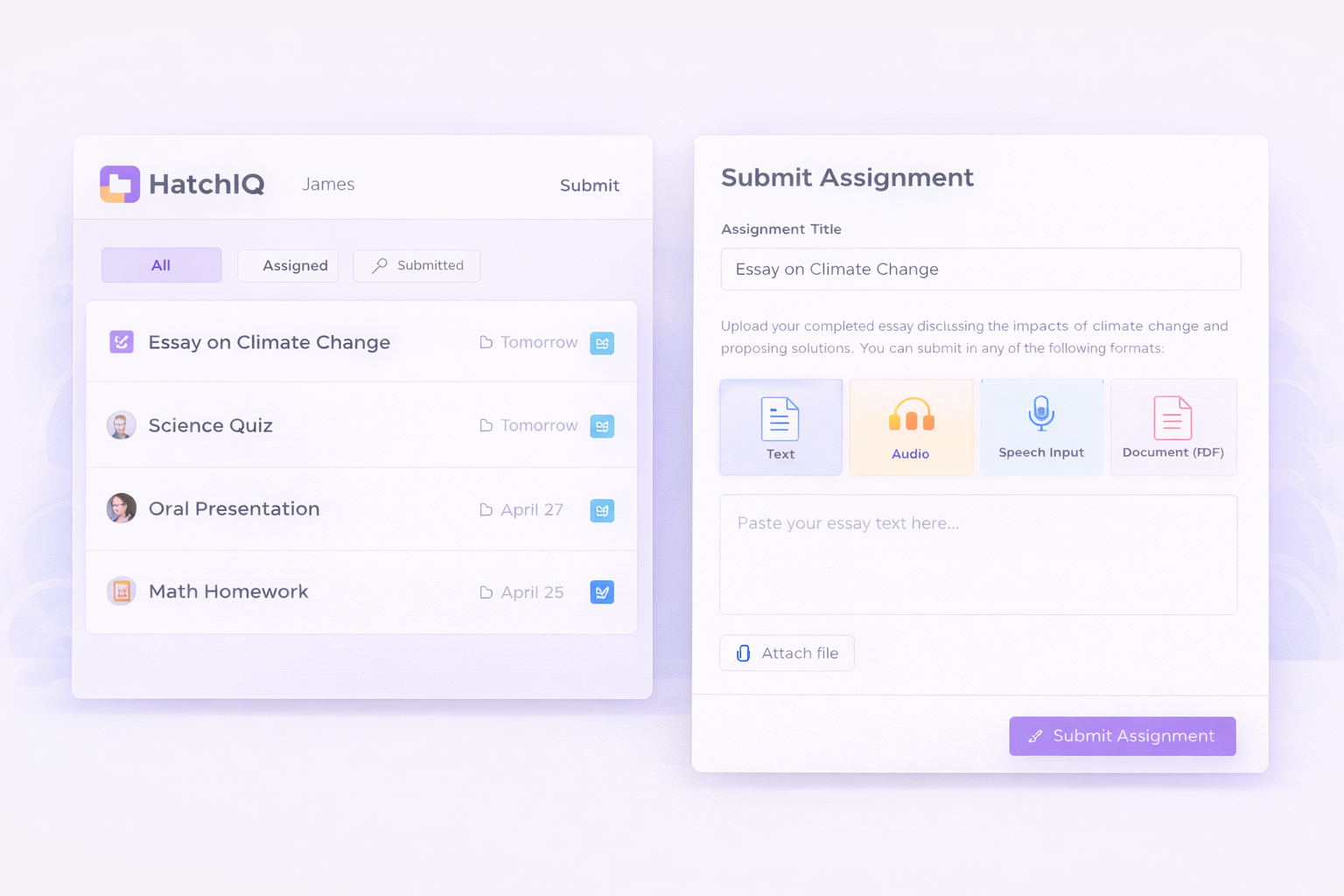
The student interface is submission-first and clarity-driven.
Students can submit assignments via:
Deadlines, grades, and feedback are always clearly visible, minimizing confusion and follow-ups.
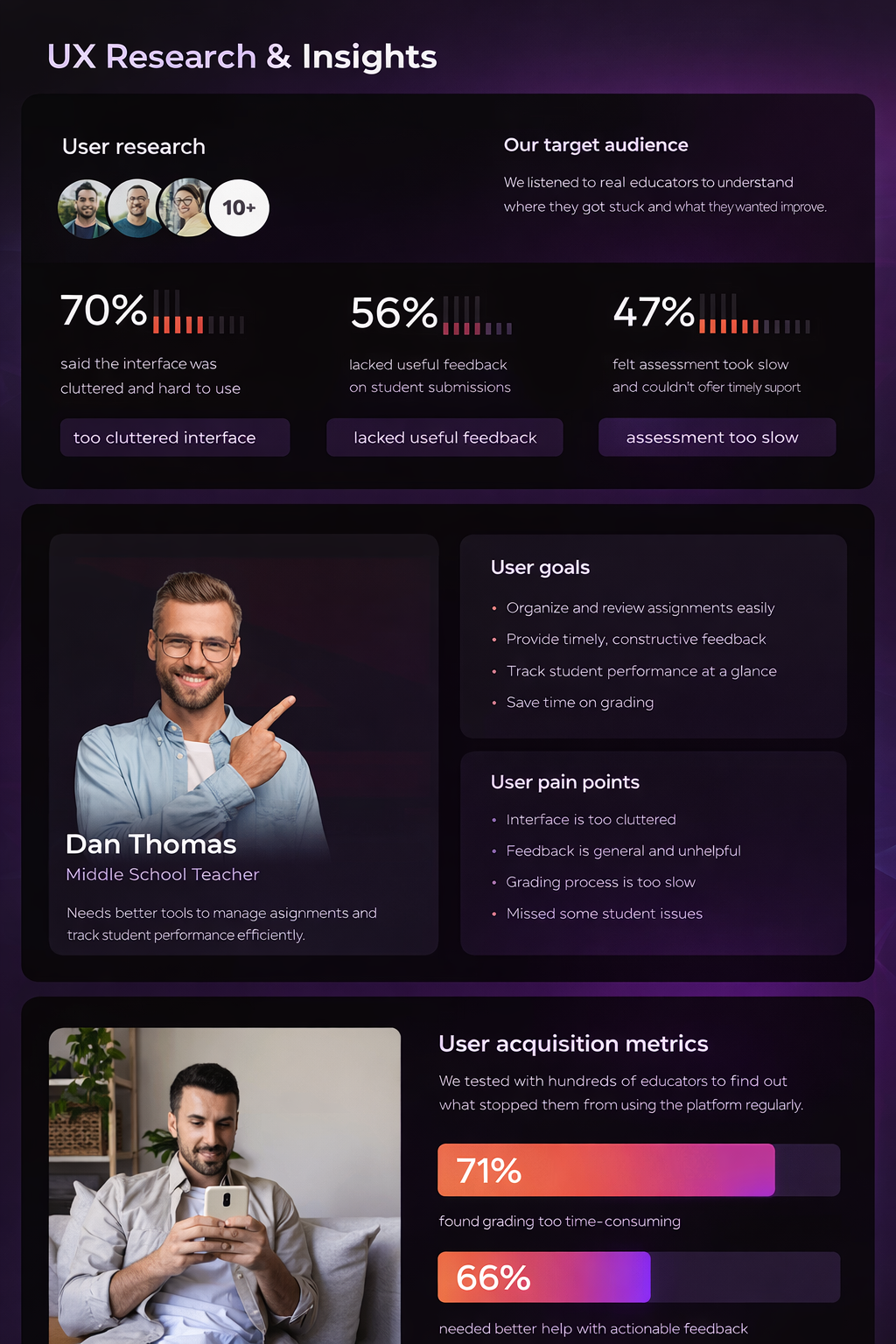
Key research findings included:
These insights directly shaped both the product experience and AI strategy.
HatchIQ’s visual identity was designed to support focus-heavy educational workflows, where users spend extended periods reviewing, grading, and managing classroom data.
Instead of relying on decorative elements, the interface emphasizes clarity, hierarchy, and visual calm. Clean layouts and generous spacing reduce cognitive load during long grading sessions, helping teachers stay focused without feeling overwhelmed.
Color is used intentionally rather than decoratively. Subtle accents guide attention to key actions—such as reviewing submissions or confirming grades—without distracting users from the task at hand. Non-essential UI noise was deliberately removed so that assignments, feedback, and progress remain the primary visual focus.
The result is a professional, modern SaaS interface that feels familiar to educators while still meeting the expectations of a scalable, technology-driven platform.
To keep things consistent, easy to grow, and manageable over time, HatchIQ was created using a well-organized design system that can handle lots of data and allow for new features in
The platform uses a fully responsive grid system designed with a desktop-first approach, reflecting how teachers primarily interact with classroom tools. The layout scales smoothly across tablets and smaller devices without sacrificing readability or structure.
Consistent spacing rules allow the interface to handle complex data—such as class lists, submissions, and feedback—without appearing cluttered. This predictability helps users scan information quickly and build familiarity over time.
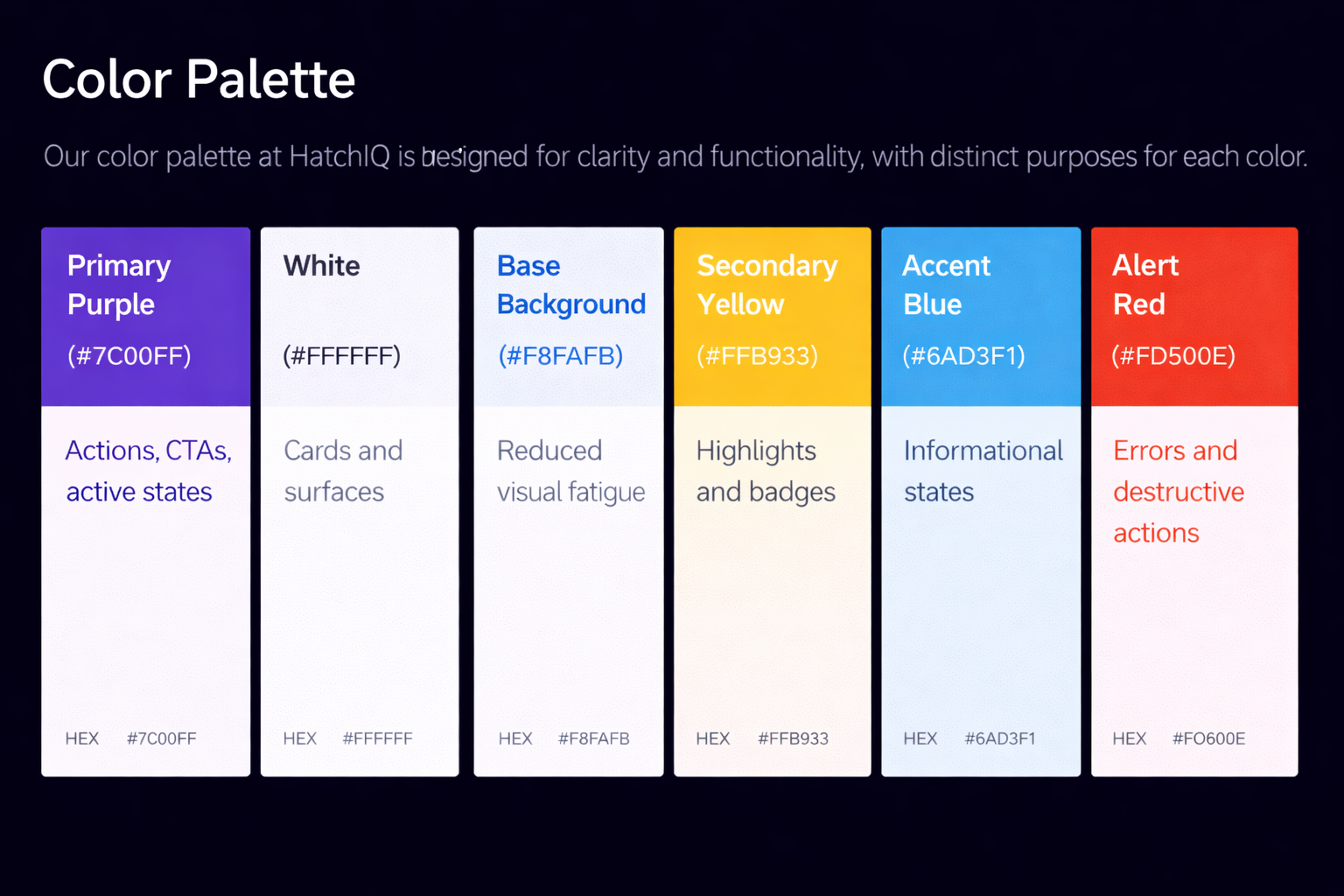
The color system was designed to communicate meaning, not decoration:
Primary Purple (#7C00FF): Used for primary actions, CTAs, and active states to clearly signal progression and decision points.
White (#FFFFFF): Provides clean surfaces for cards and content areas, improving readability.
Base Background (#F8FAFB): A soft neutral background that reduces visual fatigue during extended use.
Secondary Yellow (#FFB933): Highlights important elements such as badges, alerts, or attention indicators without overpowering the interface.
Accent Blue (#6AD3F1): Used for informational states, hints, and secondary guidance.
Alert Red (#FD500E): Reserved strictly for errors, warnings, and destructive actions to maintain clarity and trust.
This restrained use of color ensures users instantly understand what requires attention and what does not.
HatchIQ uses Avenir as its primary typeface, chosen for its clean geometry and excellent readability.
The typography system is optimized for long reading and grading sessions, with a clear hierarchy achieved through spacing and font weights rather than excessive styling. This approach supports accessibility while keeping the interface visually calm and professional.
The user experience was designed around real classroom behavior, not abstract feature sets. Each role interacts with a tailored workflow that reflects their responsibilities and priorities.
Admin Experience:
The admin experience focuses on governance, visibility, and platform-wide control. Admins can manage users, monitor activity, and maintain system integrity without interfering in daily classroom workflows.
Teacher Experience:
The system is structured around assignments and evaluations. Educators transition effortlessly between classroom administration, assignment development, submission evaluation, and feedback provision, augmented by artificial intelligence that streamlines routine activities while preserving autonomy.
Student Experience:
The platform prioritizes precision and simplicity in the student experience. Students have clear visibility into assignments, including deadlines and submission instructions, which can be completed via text, audio, voice input, or document uploads, eliminating superfluous procedures.
By aligning each role’s experience with how users already think and work, the platform significantly reduces onboarding time, training effort, and resistance to adoption.
The completed HatchIQ platform successfully translated complex classroom workflows into a system that educators could adopt with minimal friction.
Teachers were able to manage classes, assignments, submissions, and feedback from a single interface, eliminating the need to rely on multiple disconnected tools. The introduction of AI-assisted grading reduced the time spent on repetitive evaluation tasks while preserving full teacher control over final decisions.
The role-based structure ensured clarity and accountability across Admins, Teachers, and Students, resulting in smoother day-to-day usage and fewer support dependencies. Multi-format submission support improved flexibility for students without complicating the review experience for teachers.
Overall, the platform delivered measurable improvements in efficiency, usability, and workflow clarity—demonstrating that AI can enhance educational processes when applied thoughtfully and responsibly.
“Bizdesire helped us turn a complex education workflow into a product that teachers can actually use daily. The AI integration was done responsibly, not blindly.”
Product Owner, HatchIQ
"Like what you see? We can help you architect, design, and scale your next big idea just like we did for HatchIQ."
Book a call



 NDA? Absolutely — your idea stays protected.